
There is a thing every farm hand is taught about a gap in a hedge, which is that you stand in it. The herd comes at you one at a time and you are the wider of the two, and you hold until whoever is behind you gets clear. It is good sense and Bancroft has staked his life on it more than once.
It stops being good sense the moment there are two gaps.
Then you are not blocking anything, and the sooner you admit that the longer you live. What you do instead is put yourself where the ground covers your back and one side, so that only two or three can reach you at a time, and then you make yourself the loudest and most interesting thing in that room, and you let them come to you instead of going where they were going. You are not a gate. You are bait, and half the job is being worth the trouble.
The other half is knowing when to stop being it. Sometimes the bait gets swallowed, and nobody teaches you that part, and there is no bell that rings.
Bancroft spent this week in a corner, shouting, and then he ran. He swung his sword exactly once. Three people got out of that room and one did not, and the three hired men who came down with them are not coming back at all.
Two days of weather#
They did not get underground on the first day, or the second.
The rope ladder was gone again – the third one, and the third time somebody has had to sit in an upstairs room in Helix and weave one out of four sixty-foot ropes while everyone else stands around being helpful about it. Clarisse drew the job. She got halfway up the stairs before she stopped and asked what it was she had been sent to do, which Anister met with a slow hand over the face, and then she went up and did it properly and it took most of the morning.1 The party’s standing theory on the subject has hardened into law: every rope ever left out of sight in this place has been stolen, without exception, and so the thing has to be carried, and so somebody has to give up the space to carry it.
Since they were in town anyway, they hired help. Two torchbearers and a man-at-arms, all human, all of them plainly needing the work.
Caldwell had notably fresh breath, which is apparently a distinction in this town and which Bancroft was prepared to believe. Hargash smelled of fish and carried a little forked stick at his belt that he never did explain to anybody. And Manx, who was the man-at-arms, wore every god he could get his hands on – ten or so of them, small wooden things strung together at his neck like a bunch of keys – and kissed whichever one came to hand each time he opened his mouth. There was a Silvanus in the jumble. Bancroft saw it. Clarisse caught him seeing it and gave him a look and had the good sense to say nothing about it until they were out of town.
He had not decided how he felt about the man. A man who carries ten gods is not carrying any of them. But he is also a man who has been down enough holes to want the odds spread, and Bancroft had no standing to sneer at anybody’s arithmetic.
Then they walked outside into the end of the world.
The sky was black and red from one horizon to the other and there was ash coming down out of it in flakes, and something a long way north was making a noise like a mountain clearing its throat. Everyone in Helix went indoors at a run. Bolo, who has never been rattled by anything, looked out at it and said those are the Hellmouth Clouds and I would not go out there if I were you, and then went to see about the fires on his own roof.2 Clarisse wanted to know where Buffy was. Nobody could tell her.
So they paid off the hired men for the day, who took it well and kept the gold, and everyone paid for another night’s room, and the whole expedition sat in the common room and watched the sky burn.
The next morning it rained. Not clean rain – rain with mud and hot ash in it, washing the fires off the roofs, and the ash popped where it landed, so the whole town spent the morning making small explosions. Caldwell had picked up a cough overnight. They went anyway.
Anister sent the three of them down kitted properly, flint and steel and two torches apiece, and had to argue Manx into taking his. Manx pointed out that he was a man-at-arms and not a torchbearer, and that was what the two idiots were for. Anister asked him what he intended to do if the whole party died and he was left alone in the dark. Manx said he would loot the bodies, of course, and kissed one of his gods, and took the torches anyway.3
Bancroft has thought about that exchange a good deal since.
One at a time, was the idea#
They went straight for it. No exploring, no side rooms – down the shaft and east and south, back to the long hall of pillars Anister had blundered into last week while out of his mind with fear. The hall with the slabs down both sides and a dead priest laid out on every one of them, and roses and thorns cut into every slab and every wall and both of the great doors at the end.
They had a plan, and it was a good plan, and Bancroft still cannot find the flaw in it.
Clarisse would go in quiet – she is the quietest of them by a wide margin – and she would put one hand on one skeleton. Just the one. If the dead in that room woke when they were touched, then they would find that out at a cost of one, with the rest of the party standing ready in the doorway and a clear line back. Wake them singly, kill them singly. That is how you take a room like that apart without dying in it.
She went in. She touched one.
They all sat up.
Not the one. Not the near half of the room. Every priest on every slab down that entire hall, at the same moment, like one man waking. And Bancroft, who was watching from the doorway with his shield already on his arm, understood inside a breath that there was not going to be any taking of this room, and that the only question remaining was how many of them got back out of it.
Everything after that was retreat.
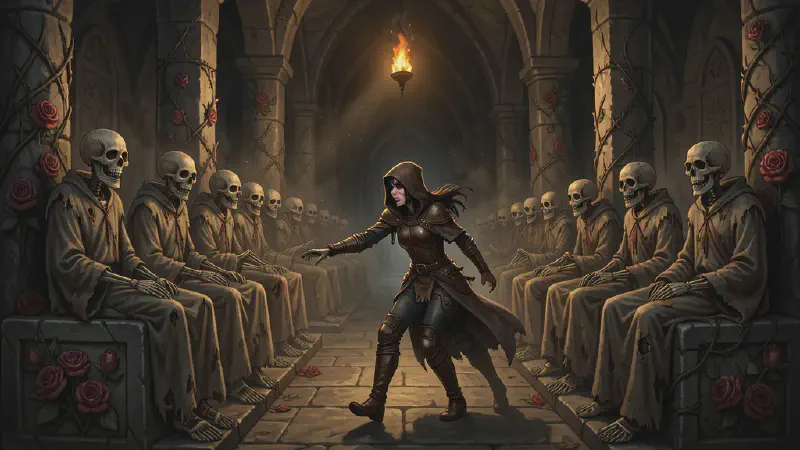
What came off the slabs#
They came in two kinds.
There were zombies, which Bancroft knows by now – slow, patient, wrong-smelling, and much harder to put down than they have any right to be. And there were skeletons, and the skeletons had been soldiers. They came on in good order with shortswords, and some of them hung back in the dark with shortbows and put arrows into people from across the room.4
That last part is worth stopping on. Bancroft has fought the dead in this place for months and every single one of them until now has had to reach him to hurt him. A dead thing that can only close with you is a problem a man can solve with a shield and a wall at his back. A dead thing that can aim does not care about your wall even slightly.
The hired men broke almost at once.
He does not blame them and he wants that on the record too. They were torchbearers. They were paid one gold apiece to hold a light, and what they got was a hall of dead priests standing up all together in the dark, and they did what any sensible man with no armor and a dagger would do. They ran. Caldwell with his cough, and Hargash with his fish smell and his little forked stick, and Manx with his ten gods around his neck and two torches he had to be talked into carrying.
None of the three of them came out of the Barrowmaze. Bancroft did not see any of it happen and does not know which of the things down there got them, and has decided he does not need to know.5
Two doors#
Here is the shape of the problem, and it is the whole of the problem.
That hall has two doors. Not one. And each of them is wide enough for two men abreast, which means each of them takes two people standing shoulder to shoulder and doing nothing else at all. Four doorposts’ worth of work. There were four of them in the party and one was an archer, whose entire value is standing well back with a clear line, and one was Clarisse, who weighs about as much as a wet coat.
They could not block both doors. They could not honestly block either one.
So Bancroft took what the ground would give him. He backed into a corner – one wall hard against his spine, another against his shield side – so that the dead could only come at him from a quarter of the compass, two and three at a time, and could not get around behind. And then he made noise.
That is not corking a bottle. It is baiting a trap with yourself, and it only works for as long as you stay worth coming at. So he stayed worth it. He shouted, and he hit things, and he called down the fury of the good and the green upon them, and the dead in that hall decided he was the thing that mattered and came for him instead of for the three people getting themselves organised behind him.
He would like the record to show what that hour was actually like, because he was not wounded is perfectly true and gives entirely the wrong picture.
They were on him the whole time. Not attacking him in the tidy way a man attacks – swarming him, three deep where they could get three deep, fingernails going over the plate hunting for a gap and finding the joints and working at them, teeth on his gauntlets, hands in his cloak. He could not always get his arm back far enough to swing. Twice the sheer weight of them nearly put him on the floor, not by any blow but by the press.6 Something got a grip and very nearly hauled him bodily out of his corner, and by rights should have managed it, and did not.7
The armor held. That is all “untouched” means. There was not one moment in that hour when something did not have hold of him.
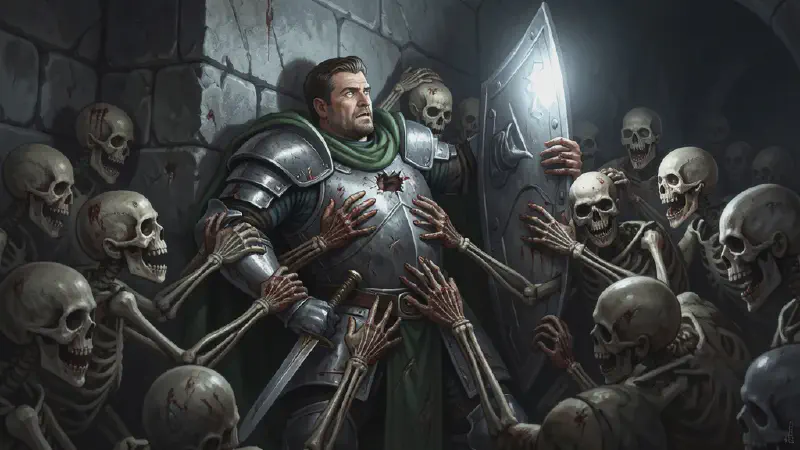
His light went out, because it always does, and he had to ask for it again with the dead piled against him, and got it.8
And the arrows kept coming the whole time, out of the dark, from things with no eyes.
The screaming#
Here is the thing about that hall that Bancroft had never met before and hopes never to meet again.
When he raised his holy symbol and started to pray, they screamed.
All of them. Every dead thing in range of his voice, all at once, with whatever they had left to scream with – ruined throats, dry throats, no throats at all – and they were not screaming at him. They were screaming to drown him out. To get between his words and the one who was meant to hear them. And the more of them there were in that room, the harder it got to be heard over it, and every single time he tried again they were readier for him and screamed sooner and screamed louder.9
He had not known the dead could be afraid. He had not, until that night, known that they knew his god’s name.
So he shouted. There was nothing else for it, so he stood in his corner with hands all over him and a wall of screaming in front of him and he shouted the only kind of prayer he has ever had, which is not a very dignified kind:
By the cow’s warm teat, by golden sheaves of wheat, By scrambled eggs on toast – it’s bacon Silvanus likes the most.
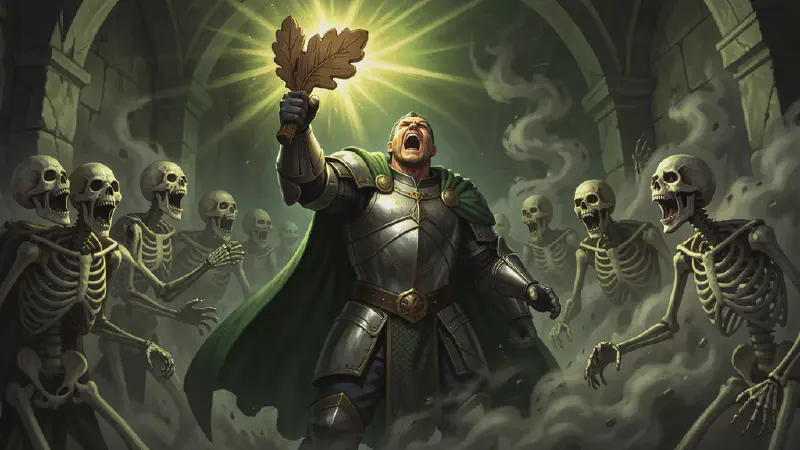
He is aware of how that sounds. He is a farmer’s son and he has no letters to speak of and the words that come to him when he is frightened are the words of the barn and the kitchen. Anister has never once made a joke about it, which Bancroft has noticed and will not forget.
The first time, it worked, and it did him personally no good whatsoever. Some of them broke off him and went scrabbling away down the hall, which bought the party a moment to get its feet under it, and the ones left simply closed the space the others had left and went back to hunting for gaps in his armor. It did not break the room. There were far too many of them for that.10
He was still buried. He stayed buried.
What Silvanus did#
They were an hour in when he made himself count.
He counted a dozen of them on him and around him and understood the thing he had been avoiding, which is that bait only works while the bait lasts. Two doors nobody was holding. Three living people behind him. A room that kept producing more dead than the four of them could put down, and every prayer harder than the last one, and them screaming before he had his mouth open.
So he put the symbol up and shouted over them again, and what came out of him this time was not about breakfast:
To the living, Silvanus says, be fruitful and multiply. To the dead, she says only: fuck off and die.
He has written before, in this same account, that turning the dead is not a mercy. He stands by it. What it usually does is blind them and set them scrabbling at the walls while his friends walk up and kill them one at a time, and he has done his share of that killing and will not dress it up as anything kinder.
This was not that.
It went out of him and across that hall like water through a broken dam, and a third of everything standing in front of him came apart into dust. Not fled. Not fell down. There was a thing with a dead man’s face reaching for the gap under his arm, and then there was a shape of grey dust standing in the air where it had been, holding its outline for about half a heartbeat, and then there was not even that. It happened on both sides of him and away down the far wall in about as long as it takes to say it. Another third turned and ran. The screaming came apart in the middle and did not get put back together.
The two that had him – the pair right on top of him, close enough that he could not get his sword arm back past them – did not come apart. They let go and ran, which he did not know they could do, and which he found he minded less than he expected to.
That is the part he felt before he understood any of the rest. The hands came off him. After an hour of being buried there was suddenly air on three sides, and room to swing, and he stood in his corner with his chest heaving and nothing at all touching him for the first time since the priests sat up.
The air was full of what was left of them. He was breathing hard and there was nothing else to breathe, so he breathed it. It was dry and old and faintly sweet and it settled in the joints of his plate and in the creases of his cloak, and it tasted, more than anything else, like the dust that comes off a hayloft floor in August. He has not managed to leave that alone since either. He has threshed grain in that same dust with his sleeves rolled up and thought it was a good day’s work.
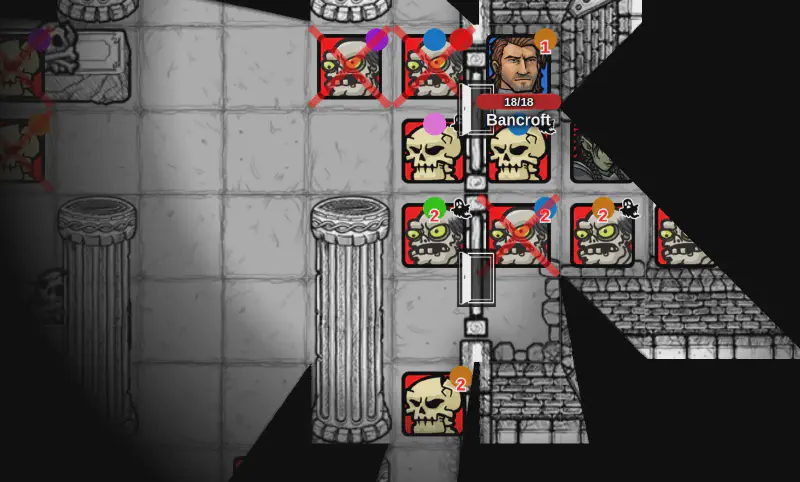
Two thirds of that room, gone or going, between one breath and the next. He came through it without a wound, which is not the same thing as coming through it untouched, and he wants that difference written down because the two get confused by people who were not there.11
Without it not one of them would have left that hall. He is not being modest and he is not being dramatic; he stood in that corner and did the sum twice and it came out the same way both times.
And here is the trouble with it. He did not do that. He shouted a piece of doggerel about bacon over a room full of screaming corpses, in the same plain words that had got him a lantern’s worth of light ten minutes earlier, and this time something answered at a volume he has never heard and men who had walked the world for centuries were unmade for it. He was the man who shouted. He was not the thing that came when he shouted.
He cannot make that sit comfortably. A man wants to know the size of the tool in his hand.
Getting out#
He had that air around him for about a breath and a half, and he spent every bit of it well.
That is what the prayer actually bought. Not the room – the room was never going to be theirs. What it bought was the one thing he could not buy for himself, which was permission to stop being bait. He got his back off that wall and moved, and got himself down the hall to where the other three were, and from there it was four people going backwards together instead of one man wedged in a hole and three trying to keep him alive from a distance. And he did not have to give up the five to get it. The god took the five and opened him a road out, in the same breath, for the price of one shouted rhyme about bacon. Nothing about that night was as generous as that one moment, and he has been careful since not to talk about it as though it were owed.
Then the ones the god had not touched – the ones who had stood there and taken it and neither run nor come apart – closed over the ground the others had left and came after him, and the rest of that night was fought on the move. The dead have no sense at all for when a thing has been decided.
It was hard grinding work with nothing clever in it. Anister was the best of them by a distance, putting shafts down the length of the hall and finding faces with them.12 Clarisse threw a dagger clear across the room and hit with it.13 Irulan stepped into the gap every time it leaked, which is the reason this account exists to be written. Bancroft got in one honest cut with the elven sword – one, the whole night.
Somewhere in the middle of it he asked for the cleansing fire, and got it, and never spent it. That is worth writing down because it is the truest thing in the whole account. He put his hand on the steel and asked, and the fire came the way it always comes, obliging and immediate and asking nothing, and then there was simply never a moment to use it – no gap, no opening, nothing standing still long enough to be burned. It guttered out on the blade while he was busy elsewhere. He asked twice and it happened twice.14
One of the zombies got up twice. Of course it did.15
And then they caught him properly.
He does not know precisely what got through. He knows that after an hour of being swarmed without a mark on him, it all arrived at once, and inside a few breaths he had taken more damage than in the whole rest of the night put together – most of what he had in him, gone between one exchange and the next.16 The armor that had held all evening simply stopped being enough. That is how it goes. It holds and it holds and it holds, and then it does not, and there is no warning in between.
So he ran in earnest. Not a fighting withdrawal any more, just running, because a man who has made himself bait and then stays out in front after the trap has closed is not brave, he is just eaten.
He asked a third time while he was going, and that was the hardest of the three by a long way, with them screaming before he had drawn breath and every previous asking still counting against him. He got there. He had to dig deeper than he has ever had to dig to do it, and he does not think he had another one in him.17
And then Irulan went down.
Bancroft does not have a clean account of it and is not going to invent one. She had spent the whole night plugging whichever of those two doors was leaking worst, and in the last of it she did not get back up, and there was no time and no room and no way to reach her. The three who were still standing went out the only way left open, which was not the way they had come in.
They went into the mongrel hideaway.
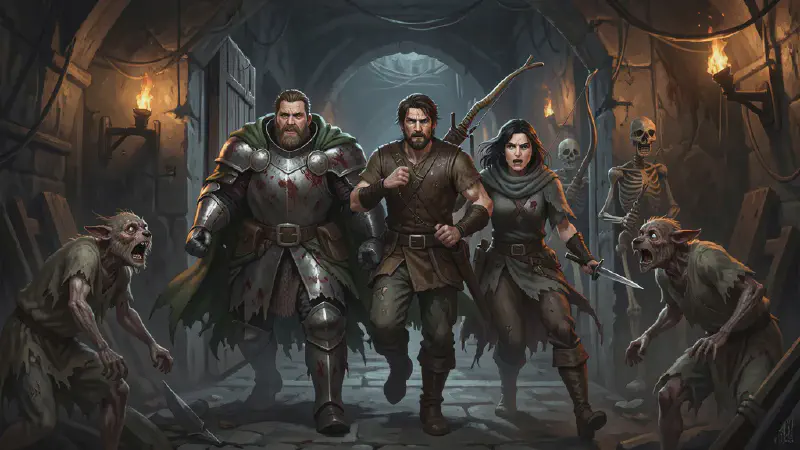
There is a joke in that and nobody was laughing. These are the same people who crowded into a doorway last week in their rags and told Bancroft to his face that he serves the Necromancer – because he is a big man in armor who walks through a graveyard and raises his hand and makes the dead crawl away from him, and if you were a frightened thing living in a hole, what else would you conclude? He tried to tell them he serves the green and growing things. They were not taking questions. They shut the door.
Tonight he came through that door at a run, with two friends and a great deal of other people’s blood on him, having just unmade a hall full of the screaming dead by shouting a rhyme about bacon.
He is going to have that conversation after all.18
The account, plainly#
It was not a rout and Bancroft is not going to write it as one.
They went in to take a room and they did not take it, and they lost Irulan somewhere in the dark behind them, and three men who trusted them enough to carry their torches are dead in a hole for two gold and a handful of silver. That is the debit column and it is a bad one.
Against it: there are a great many fewer dead things in that hall than there were, and a good number of them will not be getting up again for anybody. Anister’s bow is fine. Clarisse is fine. Bancroft is hurt, but his prayers still come when he calls them, which is the only thing about himself he actually relies on. They have a roof of sorts and people around them who are frightened rather than hostile, and time to sit down and put hands on wounds.
Rest. Heal what can be healed. Go back in.
It is not an impossible fight. It was only ever impossible at four against a room that woke up all at once, and that room is thinner now than it was, and Bancroft has stood in that corner once already and knows the shape of it.
He has been thinking about the running, and he has decided he is not going to apologise for it. A man who sets himself up as bait has agreed in advance to be swallowed, and the only skill in the whole business – the only part that is actually his and not the god’s or the armorer’s – is knowing the moment the trade stops paying and getting out. He got out one exchange later than he should have. He will know it sooner next time. That is the entire lesson and it cost him most of his blood to buy.
He would like Irulan back. He does not know whether that is a thing that can still happen, and nobody in that hideaway can tell him, and he is going to have to sit with it until somebody goes back and looks.
He has caught himself since making the offer, which is a foolish thing for a grown man to do and he has done it anyway. Put the five back. Stand them up exactly as they were, screaming, every one of them, and give her back instead. He would sign that with his own hand and think he had got the better end of it.
But nobody was ever going to put that to him, and he knows why. A hall full of priests laid out on slabs, and roses cut into every slab and every wall and both doors. Bancroft has no letters to speak of, but a man does not need letters to know a holy symbol when he is standing in a room papered with one. Roses and dead men. That was Nerull’s house they walked into, and Nerull does not trade. He does not weigh one life against five and come back with terms. He takes the five and he takes Irulan and he does not consider the two things to be related, because to him they are not a bargain, they are only the arithmetic finally coming out his way, the way it does for everybody eventually.
The only reason five of them are dust on the floor of his own temple is that Silvanus shouted louder in that room, one time, for about a breath and a half.
That is where it sits.
The party’s third stolen rope ladder. Four 60-foot ropes at 1 gp a head; the GM rules it a four-slot item at one slot per 10 feet for a 35-foot drop, and calls for Intelligence, not Dexterity, to weave it. Clarisse (Jenni) has the best Intelligence at 15 and rolls 13 – enough, and it takes most of the morning. She also buys a rope and grappling hook for 2 gp against the day the ladder goes missing again, and an olive-grey scarf for 3 silver to cover the hole in her throat. ↩︎
A lost day. The GM rolls the morning weather and produces the Hellmouth Clouds – black and red sky, falling ash, rumbling to the north. The hired men are paid off and rebooked for the following day, keeping the gold; everyone pays for another night’s room. The second morning brings rain full of mud and hot ash, which the GM notes pops and sparks where it lands. The session had opened with table talk about how rarely a character survives long enough to get a portrait drawn, and with Jenni observing that Irulan and Bancroft had both been around a good while now – “me saying this could jinx them both.” ↩︎
Two torchbearers at 1 gp each and a man-at-arms at 2 gp: Caldwell (fresh breath, a cough by the second morning), Hargash (smells of fish, forked stick at his belt), and Manx (leather and shield, hand axe and dagger, roughly ten wooden holy symbols on a keychain – one of them Silvanus – kissed at random whenever he speaks). Anister (graham l.) spends 45 silver kitting them out and wins Manx over with a Charisma check the GM answers with “just this once.” On the way out Clarisse rolls a d6 for the journey and gets a 2, which the GM confirms saved them from an encounter; he checks the party’s average level against the wandering-monster table and finds it is not quite four. ↩︎
The plan was for Clarisse to sneak in and touch a single skeleton, on the theory that the room’s occupants would wake one at a time and could be fought that way. Every one of them woke at once, and the rest of the session was a fighting retreat. The hall has two doors, each two squares wide – four bodies’ worth of blocking for a party of four, one of whom is an archer – so holding the room was never on the table. Bancroft instead anchors a corner with walls on two sides, limiting the dead to two or three at a time, and plays for their attention. Two enemy groups roll initiative separately – zombies at 12.06, the second group at 8.14. Zombies attack with Slam (+2); the skeletons carry Shortsword (+1), and some of them shoot shortbows at far range, which is new for this party. The fight runs from roughly 21:37 to the end of the session, better than two hours of real time. ↩︎
Caldwell, Hargash and Manx all fail their morale checks and flee. None of them is accounted for afterwards, and the party’s assumption is that they died offscreen somewhere between the hall and the surface. ↩︎
The zombies land a great many attacks on Bancroft over the hour and achieve remarkably little, several of them critical hits (22, 22, 22, 20) that still fail to move his total meaningfully; the map shows him at 18/18 a full hour into the fight. Slam damage runs 1 to 5 a hit, with a healthy share of fumbles. Taking no damage is not the same as being left alone – the GM plays it as constant swarming, clawing and biting at the gaps in the plate, with Bancroft nearly overborne by weight of numbers more than once. ↩︎
A Strength contest in the middle of the fight: Bancroft rolls 14, the GM rolls 20 with advantage – a decisive loss. He is in his corner before it and in his corner after it. ↩︎
Bancroft’s Light goes out mid-fight as usual. He recasts at 19 against a DC of 11, and again at 12 a minute later. ↩︎
This level runs a house rule on Turn Undead: a -1 penalty per undead creature the turning can affect, plus a further cumulative -1 for every previous attempt. The GM narrates the mechanic as the undead screaming whenever Bancroft begins to pray – deliberately trying to drown out Silvanus’s voice – which is why a crowded room and a long fight both make the prayer harder. Bancroft attempts it three times over the session and succeeds all three, the last one only by spending a luck point. ↩︎
The first Turn Undead comes up a natural 20 for a total of 24. It peels some of them off down the hall without breaking the room or relieving the press on Bancroft himself – only the second casting clears him any space. ↩︎
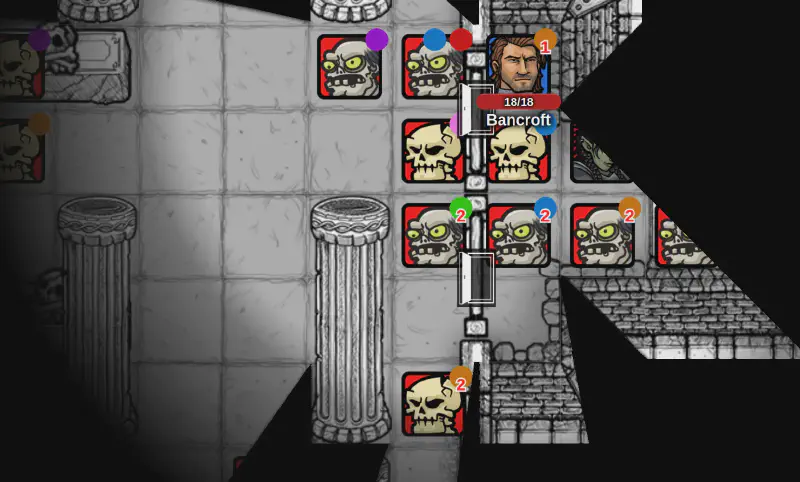
The night’s centerpiece: Turn Undead with a spellcasting check of 23, against the stacked penalties above. Eleven undead roll Charisma checks and most fail catastrophically – 3, 3, 11, 3, 8, 5, 10, 2. In Shadowdark a creature that fails by 10 or more and is of a level no greater than the caster’s is destroyed outright; otherwise a failure means it flees for 5 rounds. By the table’s reckoning it destroyed about a third of the enemy and put another third to flight, and the party’s assessment afterwards was that without it nobody would have survived. The two screenshots are the battle map before and after: within the visible frame, five tokens struck out (destroyed) and four marked with ghost icons (fleeing), two of those ghost markers partly hidden behind the open-door graphic and Bancroft’s own nameplate, with Bancroft still at 18/18 throughout – swarmed and grappled for an hour without taking a point of damage, not left alone. It does not hold much past this point. The table’s verdict on a man in plate soaking a room for two hours with an Intelligence modifier of -3 was, inevitably, “Hodor.” ↩︎
Anister’s best stretch of the night: back-to-back Long Bow (+4) shots at 22 and 21, with maximum damage on both foebane dice on one of them, and later a 20 for 13. ↩︎
Clarisse lands a thrown dagger at 20 at far range for 9, and puts a short bow shot in for a critical damage die. ↩︎
Cleansing Weapon twice (18 and 19 against DC 12) – a weapon wreathed in purifying flame for an extra 1d6 against undead over 5 rounds. Neither casting is ever cashed in; the fight never offers the opening. Bancroft’s only weapon attack of the entire session is a single Elvish Longsword hit for 2. ↩︎
A zombie makes its Constitution check to get back up after being put down – the same mechanic that turned last session into a running joke. ↩︎
Shortly after the second turning Bancroft takes 13 damage in quick succession – more than the whole rest of the session combined, and the bulk of an 18 hit point total. He abandons the corner and withdraws. ↩︎
The third and hardest Turn Undead, at 19 with the full stack of penalties against it, bought with a luck point. Six Charisma checks answer it and the survivors hold up far better – a 21 critical among them. ↩︎
Irulan falls, and Bancroft, Clarisse and Anister break into the mongrel hideaway – the mongrelmen the party parleyed with badly last session, who accused Bancroft of serving the Necromancer. A Mongrelman rolls initiative at 23:45 and the session ends four minutes later, with Irulan’s fate unresolved. ↩︎